
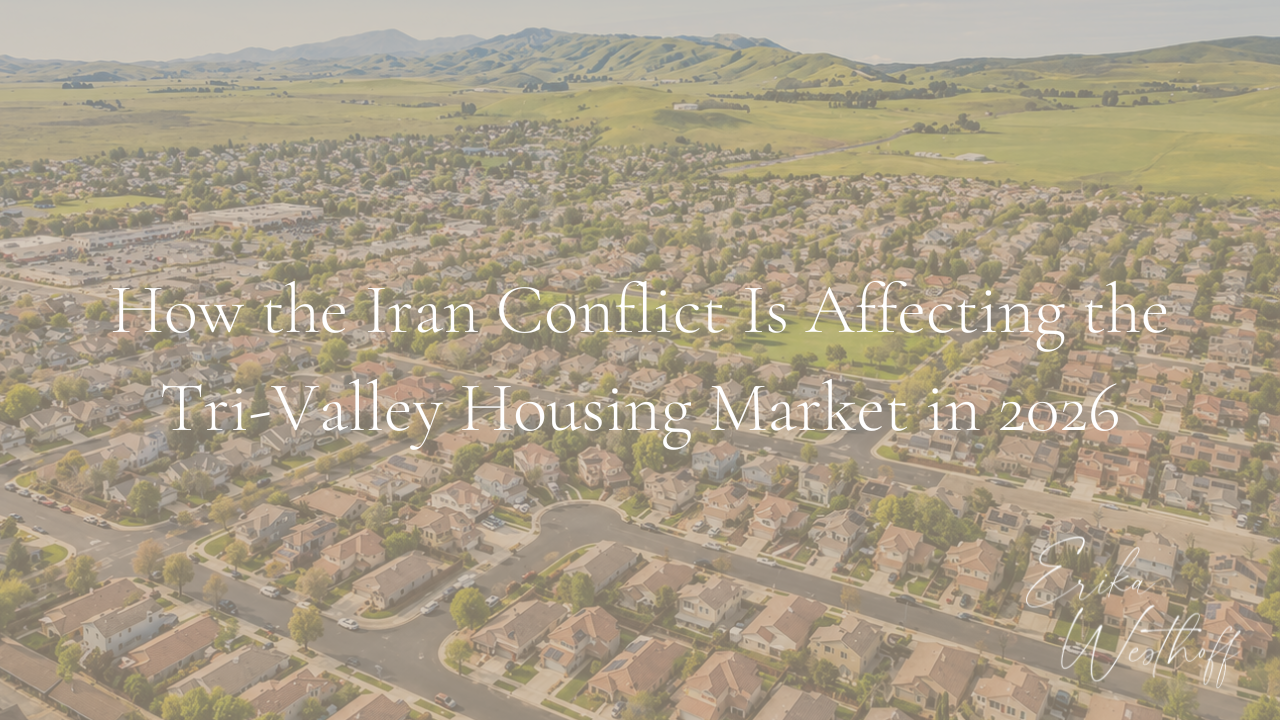
How the Iran Conflict Is Affecting the Tri-Valley Housing Market in 2026
Over the past several weeks, many buyers and sellers have asked me the same question:
"Should I wait to buy or sell because of everything happening in the Middle East?"
It's a fair question.
Whenever there's an international conflict, especially in oil-producing regions, financial markets tend to react quickly. Stock prices fluctuate, oil prices shift, and mortgage rates often respond almost immediately.
But here's the important distinction:
The headlines have changed much faster than the housing market has.
Let's take a look at what the data is actually telling us.
Why the Iran Conflict Matters to Real Estate
The conflict involving Iran has primarily affected the housing market through one channel:
Mortgage interest rates.
As geopolitical tensions increased, investors worried that higher oil prices could fuel inflation. Inflation makes it more difficult for the Federal Reserve to lower interest rates, which in turn pushed Treasury yields and mortgage rates higher than many economists had expected earlier this year.
For buyers, even a modest increase in mortgage rates can significantly affect monthly payments.
For sellers, higher rates reduce affordability, meaning buyers become more selective and price-sensitive.
What We're Seeing Nationally
Across the United States, the housing market has slowed, but it hasn't stopped.
Recent data shows:
Existing home sales declined about 2.4% in June compared with May.
The national median home price reached a record $440,600.
Inventory has gradually increased but remains below historical norms.
Mortgage rates remain in the mid-6% range after moving higher following renewed geopolitical uncertainty.
In other words:
This isn't a housing crash.
It's a housing market that has become much more selective.
Why the Bay Area Is Different
The Bay Area has always followed its own economic rhythm.
Unlike many parts of the country, our housing market is driven by:
High household incomes
Strong technology and healthcare employment
Limited land available for new construction
Long-term homeowner equity
Consistently high demand for desirable communities
These factors create a much stronger foundation than many national markets.
While buyers have become more cautious, well-priced homes continue to attract strong interest, especially in neighborhoods with excellent schools, shorter commutes, and desirable lifestyles.
What We're Seeing Here in the Tri-Valley
Communities like Danville, San Ramon, Pleasanton, Dublin, Livermore, and Alamo continue to benefit from something buyers value more than ever:
Quality of life.
Even as interest rates remain elevated, buyers are still relocating for:
Better schools
More space
Remote or hybrid work flexibility
Outdoor recreation
Family-friendly neighborhoods
The biggest change isn't demand.
It's buyer behavior.
Today's buyers:
Take longer to make decisions.
Negotiate more than they did in 2021 or 2022.
Expect homes to be well-prepared before they write an offer.
Have more choices than they've had in several years.
For sellers, that means presentation and pricing matter more than ever.
If You're a Buyer...
Uncertainty often creates opportunity.
Many buyers assume they'll wait until rates fall.
The challenge is this:
If mortgage rates decline significantly, many buyers who have been waiting on the sidelines are likely to re-enter the market at the same time.
That typically means:
More competition
Multiple offers
Faster-moving inventory
Greater upward pressure on prices
Today's market often provides something buyers haven't enjoyed in years:
More negotiating power
Inspection contingencies
Time to think through decisions
Greater inventory to choose from
Remember:
You can refinance a mortgage.
You can't go back and buy today's home at yesterday's price.
If You're a Seller...
Many homeowners are waiting because they have a 3% mortgage.
That's understandable.
But delaying isn't always the best financial decision.
Ask yourself:
Does the home still fit your lifestyle?
Are maintenance costs increasing?
Are you missing opportunities elsewhere?
Would moving improve your daily life?
Today's buyers are still purchasing homes.
They're simply rewarding sellers who prepare their homes well, price strategically, and understand today's market expectations.
The sellers experiencing the greatest success are the ones who adapt, not the ones waiting for "perfect" conditions.
The Bottom Line
Global events like the Iran conflict absolutely influence financial markets.
They can affect mortgage rates, consumer confidence, and short-term market activity.
But they haven't fundamentally changed why people move.
Families still grow.
People retire.
Jobs change.
Children start school.
Life continues.
In the Tri-Valley, those life events continue to create housing demand regardless of international headlines.
Whether you're buying your first home, moving up, downsizing, or planning your next investment, the best decision is rarely based on the news cycle.
It's based on your personal goals, your financial situation, and having a strategy that fits today's market, not last year's.
If you're wondering whether now is the right time to buy or sell, I'd be happy to help you evaluate your options with current local market data and a personalized plan. Sometimes a 20-minute conversation is all it takes to replace uncertainty with clarity.
Erika Westhoff,
Founding Member, Northern California
SERHANT.